Use an NTC Power Thermistor
Inrush Current
Switching Power Supplies (SPS) that have low impedance capacitors will expose the diode-bridge-rectifier to high inrush current at turn-on. Protecting the Bridge Rectifier from inrush current is critical. How to stop inrush current is a the key question.
Inrush Current Protection of Switching Power Supplies
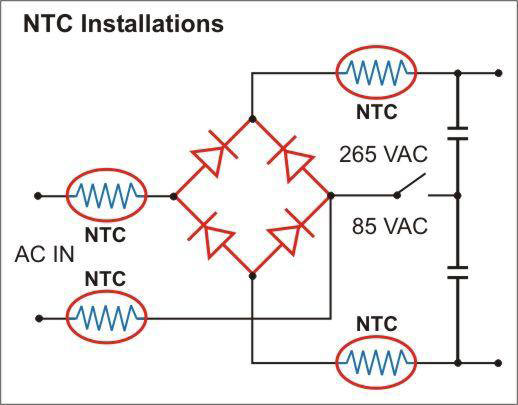
This application note provides some design considerations to stop inrush current and protection of the AC current applicable to Switching Power Supplies (SPS). The solution suggested in this application note uses an NTC Power Thermistor in separate legs of the power supply circuit (see Figure 1). This NTC Power Thermistor offers high resistance at the beginning of switching and limits the inrush current. After a short time, the NTC Power Thermistor resistance decreases to a low value due to self heating and does not affect normal operation.
Inrush current explained very simply is the current drawn by a piece of electrically operated equipment when power is first applied. It can occur with AC or DC powered equipment, and can happen even with low supply voltages.
By definition, inrush current is greater than the normal operating current of the equipment, and the ratio can vary from a few percent up to many times the operating current. A circuit that normally draws 1A from the mains may easily draw 50 to 100 times that when power is applied, depending on the supply voltage, wiring and other factors. With AC powered equipment, the highest possible inrush current also depends on the exact time the load is switched on. Elliot Sound Products
NTC Selection Criteria: Steady State Current
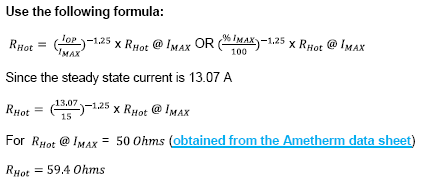
First determine the 100% load of the switching power supply (SPS). 100% load:

Assuming, the SPS has wattage of 1000 W and efficiency 90%
NTC Selection Criteria: Minimum Resistance at 25

NTC Selection Criteria: Minimum Resistance at 25
Minimum resistance should limit the one-cycle maximum current rating of the diode-bridge rectifier, for example, to 50% of its rating for adequate surge protection.
If the desired maximum input rush current is: 100 A (when peak current rating is) And Peak voltage: 375 Volt (for 265 V AC)

Note: Use the Resistance Temperature Conversion Table – to find the resistance – if the operating temperature is other than 25.
NTC Selection Criteria: Energy
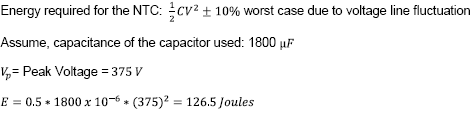
NTC Selection Criteria:
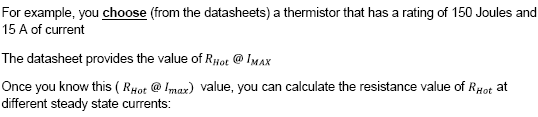
Select a Thermistor that can handle 13 A of current and has a capacity of at least 126 Joules, which will stop the inrush current. Use our Inrush Current Calculators.